
The Science
Creative Test combines decades of real-world shopper psychology with modern AI. Our algorithm is built on more than 40 years of applied experience, including the work of Phillip Adcock, who spent 25 years consulting for many of the world’s biggest brands and 70% of the Grocer Top 100. We have taken the work he did as a consultant, that consistently worked in aisle and trained an AI to measure it quickly, consistently, and at scale.




Our behavioural evidence base
Our tool is based on a living knowledge base of established psychology and behavioural science :
- 1,500 specific shopper insights
- 1,071 peer-reviewed academic papers
- 2,000+ shopper research projects
- 392 specialist textbooks
This database is continuously updated as new, proven behavioural insights emerge.
Key Ideas
Creative Test exists, in part, so you don’t have to understand or use Behavioural Science yourself, and we’re never going to do the full subject justice on a company website. So, for now, here are summaries from three leading thinkers that we think you’ll find interesting and useful
System1 & System 2 (Kahneman, 2011)
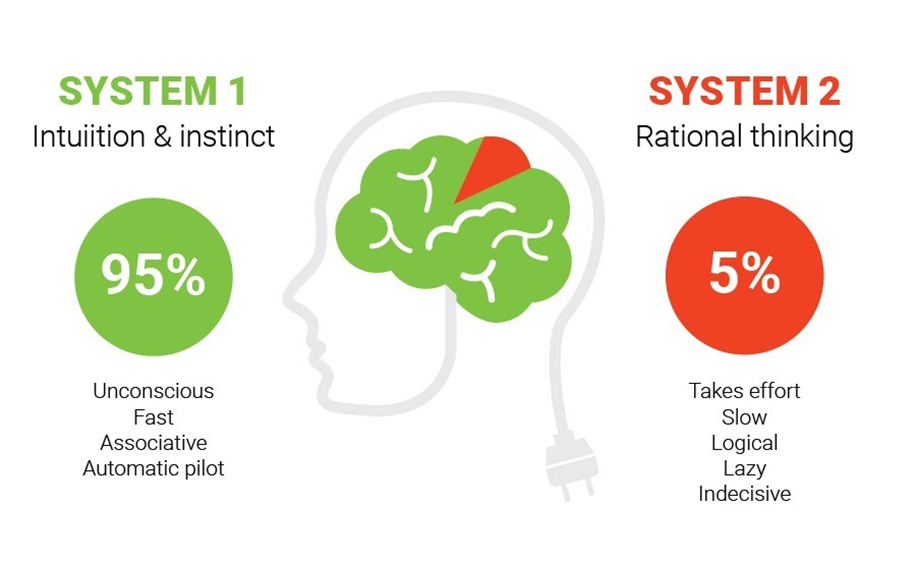
Daniel Kahneman described two modes of thought that shape every decision we make.
System 1 is fast, automatic, and intuitive , it runs on emotion, habit, and mental shortcuts. System 2 is slow, deliberate, and analytical, it steps in when we need to focus, calculate, or reason carefully.
Most everyday choices, including what we notice and buy, are driven by System 1. It’s efficient, effortless, and largely unconscious. System 2 acts as a supervisor, but often just rationalises decisions our intuition has already made.
Understanding these two systems helps explain why design, emotion, and fluency matter so much: they influence System 1’s instant reactions before System 2 ever gets involved.
Evolutionary Toolbox (Gigerenzer & Todd 1999)
The brain has an evolutionary toolbox of fast and frugal heuristics (mental shortcuts) that help us make effective decisions with limited information. This is a similar approach ‘System 1’ but with a much more human positive spin. Gigerenzer’s work has shown that expert ‘ecologically rational’ decision making outperforms ‘rational’ decision making in many instances.
His work has identified some heuristics that we think beautifully describe how many decisions are made in the domain of Supermarket shopping
- Take the Best (e.g. this one’s got… that’s enough)
- Recognition Heuristic (e.g. I’ve heard of this brand)
- Fluency Heuristic (e.g. this product is understand, so my brain assumes it’s the better choice)
These may mean we don’t always choose the perfect option, but we will make ‘ecologically rational’, decisions. How long is it ‘worth’ spending choosing cereal, does it really matter if we choose the one with slightly less fibre, more calories, higher £ per g ?
What is behavioural science?
Our brains have been evolving, as Homo Sapiens, for about 300,000 years. The first self-service Supermarket was in 1926.
We’ve survived and evolved because our brains learned to prioritise, and automate much of our decision making (Fight,
Flight, Food, Find a Mate). Stopping to debate if that Lion looks hungry is not a good survival tactic.
The mental tools we developed to survive in the ancient world haven’t changed as fast as the environment and context in which we live. That can lead to human decision making being perceived as ‘irrational’. That’s more a question of perspective, we’d argue it’s more irrational to expect human’s to logically, carefully weigh up the pros and cons of every single decision we make. Faced with 40,000 products in a large supermarket how long would we have to spend shopping?
Behavioural science is the study of how people actually think, feel, and act. It combines insights from psychology, neuroscience, sociology, and behavioural economics to understand human behaviour and decision-making. Rather than assuming people are fully rational, it explores the ways we use mental shortcuts, emotions, and learned patterns to make choices in complex environments. In simple terms, behavioural science helps explain human decision making, and how external factors and context shape our behaviour.
If we understand how human’s make decisions we can make it easier for them to choose our brands or products!
Bounded Rationality Satisficing (Simon 1956)
The bounded rationality theory recognises that people make judgments based on a limited amount of information, time and cognitive capacity.
It would be irrational , even impossible , to weigh every variable for every choice we make. Do we search online reviews and check the provenance of brand of rice on the shelf or….?
In contexts like supermarket shopping we rely on what’s available, familiar, and easy to process and select the first that meets our needs rather than seeking the absolute best option. Simon called this process satisficing. It’s a deeply human and efficient strategy, reflecting how real-world decisions are made under constraints.
If you observe shopper behaviour, you can easily see satisficing in action: people reach for what’s on the shelf, what they recognise, and what feels simplest to choose.
It’s the same principle that modern evidence from Ehrenberg-Bass reframes as mental and physical availability, salience and accessibility drive choice; people choose what feels familiar and is easy to find.

Behavioural Science and Shopper Marketing
Whether by accident or design every piece of Shopper Marketing influences decision making through subtle behavioural cues
and triggers.
These shape what people notice, attend to and ultimately, buy.
Many of these cues and triggers have been identified through decades of research and real-world observation. It’s that research which underpins Creative Test for example, when a product display feels simple and easy to process, it activates our sense of fluency, the brain’s preference for effortlessness. We instinctively trust it more. When a claim highlights that others are already buying or loving a product, it taps into social proof, our deep-seated drive to follow the choices of others when we’re uncertain. Small adjustments in imagery, colour, and text can have outsized effects on what people choose and can either help or hinder people to select that product. It’s not manipulation, it’s understanding human nature.
In practice, behavioural science means designing communication to work with the brain, not against it, we call this ‘Psychological Effectiveness’
That’s why Creative Test analyses the same underlying psychology .not to exploit it, but to make your brand and products easier to see, understand, and prefer.